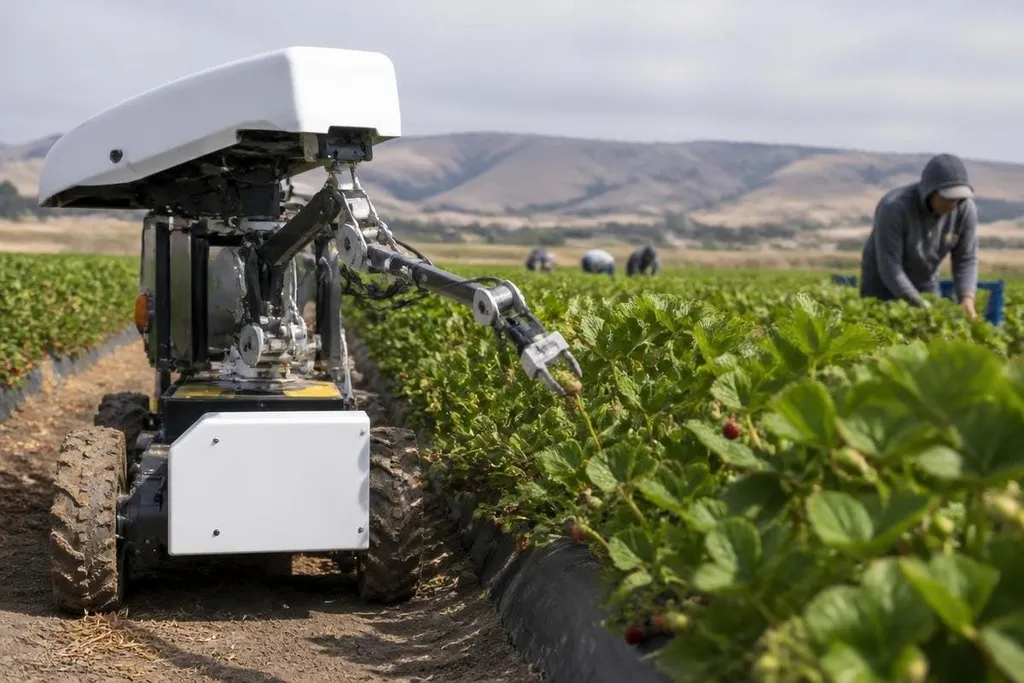
A harvesting robot must find ripe produce, pick it without damage, and repeat the task across uneven ground. That makes farm harvesting one of the hardest jobs for automation, even when the labor gap is clear.
- Cameras and software judge which crops are ready to pick.
- A gripper must handle soft produce without bruising it.
- Human crews will still cover crops and conditions robots can't manage.
Why harvesting is hard to automate
A factory robot works in a fixed space with known parts. A farm changes by the hour. Leaves hide fruit, sunlight shifts across the field, and produce on the same plant can ripen at different times.
The robot first uses cameras to find a crop. Software studies shape, color, and position before the arm moves toward it. This is a vision system, meaning cameras and software that help the robot understand what sits in front of its gripper.
That decision must be accurate enough to avoid two costly errors. The robot can pick produce before it is ready, or leave ripe produce behind while moving to the next plant. Both errors reduce the value of the machine.
The arm then needs a careful grip. A tomato, apple, or berry can lose its sale value if the robot squeezes too hard, pulls at the wrong angle, or drops it during the handoff. The tool at the end of the arm is called an end effector. For harvesting, it may cut a stem, twist a crop free, or hold it with soft contact surfaces.
What a farm could gain
A harvesting robot works best when it takes on a narrow, repeated task. It may run during hours when finding workers is difficult, or return to the same rows after a human crew has picked the easiest produce.
That changes the labor problem rather than removing it. People may spend less time on repeated picking and more time checking plants, moving filled containers, handling damaged crops, and managing the robot.
The farm also needs more than an arm. A mobile base carries the system between rows, while cameras or other sensors help it avoid plants, posts, irrigation equipment, and people.
A battery sets the work period, and charging or battery changes affect how long the robot can operate. The crop and field decide the business case.
A robot made for orderly rows may struggle in a field with dense leaves or uneven soil. A machine that needs a clear route may need changes to row spacing, ground cover, or collection points before it can work well.
Those changes affect how much farm labor a picker can replace. A farm operator can use Robot24.com farm robotics reports to check the crop, test date, picking rate, and human work left after each trial. The next section turns to the limits that remain.
Where the limits remain
A farm owner should ask for results from the exact crop and task under review. A robot that detects ripe produce in a controlled demonstration has not yet proved that it can keep that rate across dust, rain, glare, tangled plants, and a full harvest period.
The handoff also deserves attention. Picking is only one step. The crop must reach a container without damage, and the container must move away before the robot stops. If people must reset the machine every few minutes, the farm may gain little labor capacity.
Maintenance can add another burden. Cameras need cleaning, grippers wear, software needs updates, and field equipment faces water, dirt, and vibration. A technician may be needed to fix the robot during a narrow harvest window.
Cost is another open point. The purchase price is only one part of the decision. The farm must also count power, repairs, software fees if any, worker training, transport, and the changes needed to prepare the field. Without those figures, claims about savings are incomplete.
I'd treat a harvesting robot as extra farm equipment, not a replacement for a crew.
A buying check for farm operators
Before a trial, write down the task and the result the machine must reach:
- Name the crop: Confirm the robot was built for that crop, plant shape, and harvest method.
- Set a quality limit: Count damaged, unripe, and missed produce during the test.
- Measure human work: Record how many people load containers, clear jams, and reset the robot.
- Check field fit: Test row width, slope, soil, glare, dust, rain, and nearby equipment.
- Price the full run: Add power, service, training, software, and field changes to the purchase cost.
- Ask for proof: Request results from a working farm, over a defined period, with the crop named.
A useful trial should end with records a farm manager can inspect, not a video of a few successful picks. The next question is whether the robot can keep its picking quality after the field, weather, and workload stop being predictable.